
On the controversy surrounding the GDP numbers based on new calculations, he said statisticians have done as good a job as they can and economic growth is significantly high as costs have come down

Prime Minister Narendra Modi had announced a relief package of Rs 20 lakh crore or about 10 per cent or GDP last week. However, many of the measures unveiled have been in the form of moves like loan guarantees which do not entail an immediate fiscal cost.

There are various estimates of India's debt to GDP ratio, but the consensus is that that it would be over 80 per cent at the end of the current fiscal year.

Fitch Ratings director Thomas Rookmaaker said India's debt-to-GDP ratio is likely to rise to 76 per cent from 70 per cent currently due to wider fiscal deficit and low economic growth.

The review stresses on creating conditions for growth that is employment-friendly.

To threaten China and Pakistan, and then to sharply cut back on military funding, bespeaks a remarkable trust in Beijing and Islamabad that is not borne out by anything they say or do, notes Ajai Shukla.

Other countries with a large number of cases including Brazil, Russia, Spain and the United States of America, all have more people heading to work.

Real consumer spending grew four per cent at an annual rate in the third quarter, substantially up from the 2.6 per cent pace during the preceding four quarters

Even with the possible expenditure roll-overs and off-budget financing, the fiscal deficit target will not be met. The FRBM Act, after its amendment in 2018, allows a fiscal deficit slippage of not more than 0.5 per cent for any given year, provided there are justifications. These justifications include war, national security, severe collapse in the agriculture sector, a major natural calamity, big structural economic reforms, or the decline in real output growth of a quarter by at least 3 percentage points below its average of the previous four quarters.

The government further said the gross tax revenue as a per cent of GDP is expected to increase to 12.1 per cent of GDP in 2019-20 and stabilise at that level in 2020-21 before climbing up to a level of 12.2 per cent of GDP.

'China seems more intent on creating a new world order rather than shaping the existing one.' 'India is of course, at this moment in time, aligned with the West-led order because of China's full-spectrum aggressive behaviour towards India.'
Some experts argue that India's new growth figures are due to the revised calculation of GDP, which was launched in January
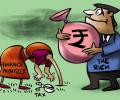
While the tax-to-GDP ratio of 9.88 per cent has been assumed for FY21, the same as last year, when it touched a decadal low, for FY22 a ratio of 10.7 per cent has been assumed, an average of the last five years.

Budget for 2022-2023 has returned to its agenda for protectionism in the name of creating a self-reliant India, points out A K Bhattacharya.

'We can go somewhere between 35 per cent and 40 per cent.'

RBI must balance the need for improving domestic bank credit demand and respond to lower inflation.
Aakar Patel looks forward to Prime Minister Modi's speech at the bhoomi pujan for the Ram temple in Ayodhya next week. It will be entertaining and stirring, predicts Aakar, and make lots of promises that he most likely won't be able to keep.

'Do not get into the calculations that you see on television...Oh if you are looking at $5 trillion economy, the country will have to grow at 12 per cent, today it is growing at 6-7 per cent'

Europe reigns supreme among the world's most innovative nations.

'I believe the modified scheme is much more beneficial and simpler.'

Govt issues draft on new index calculation; other sectors to follow suit in phases.

Almost all infrastructure ministries continued spending on capex throughout the lockdown, even as the Centre tried to maintain some semblance of economic normalcy.

The government must expedite its plan for asset sale and privatisation, both of which hardly got any mention in the Budget speech, points out A K Bhattacharya.

Taking a jibe at the Bharatiya Janata Party for demanding an apology for his "rape in India" remark, Gandhi said, "My name is Rahul Gandhi, not Rahul Savarkar. I will never apologise for speaking truth and nor will any Congressman do so. It is Narendra Modi and his assistant Amit Shah who has to apologise to the country for destroying India's economy."

Recovery of the Indian economy depends to a great extent on acceleration in the spending of these relatively richer households, explains Mahesh Vyas.

The stock market, the Survey felt, had run away from underlying real economy indicators and asked if this indicated rational confidence or irrational exuberance.

India's economic image is not affected due to Adani Group's recent decision to pull out Rs 20,000 crore FPO (follow-on public offers) amid allegations of financial wrongdoings, Finance Minister Nirmala Sitharaman said on Saturday.

Indian economy grew at 7.9 per cent in fourth quarter of 2015-16.
Experts say it will now be tough for the Modi government to catch up with the UPA's economic record owing to the shock induced by the currency demonetisation.

'Very few of small investors stay invested for those three or four or five years.' 'If there's like a six month, one-year period when market is not doing well, you exit.' 'After the market has run up, you get in again.' 'This way you will never make returns.'

According to the Central Statistics Office data, the jump in the retail inflation based on Consumer Price Index was mainly due to rise in prices of kitchen items like vegetables, meat and fish.

Economic growth was revised from 4.7 per cent in FY14.

Congress trained its guns on the National Democratic Alliance dispensation on a wide range of issues including economy, employment, price rise and foreign policy.

The benefit coming in from the Rs 1.45 lakh crore tax giveaways will also help companies to cut prices by up to 5 per cent to boost consumer demand, which has been sagging and is one of the prime reasons for the deepening slowdown.

Heading G20 will give India a foreign affairs year like it has never had in history. You can trust Narendra Modi to exploit this to India's benefit. And, of course, to his own in his election year, explains Shekhar Gupta.

Concerned by GDP slowdown and unrealistic tax targets, the economists urged Finance Minister Nirmala Sitharaman to implement long-term structural steps like land and labour reforms. Warning against any off-Budget financing the economists said the government should prepare a statement of intent for its social, rural and welfare sector expenditure.

When we look at the pension expenditure of the states, so far, there has been no gain from the NPS reform. Pension expenses as a share of total state revenue expenditure rose from 4% in 1991-1992 to 10% at the time of the NPS reform, and have risen further to about 12%, observes Ajay Shah.

The average wealth expectancy of those in India with enough disposable income to save and invest is just Rs 3.6 crore and this would give them Rs 93,000 per month to live during retiremen. On an average, this would give the affluent class Rs 93,000 to live on per month during retirement, which is less than both their current income and wealth aspirations.

Maybe the new methods of measuring GDP helped us get an accurate picture.
Releasing a report titled 'Profiting from Pain' in Davos, the rights group further said as the cost of essential goods rises faster than it has in decades, billionaires in the food and energy sectors are increasing their fortunes by $1 billion every two days.
